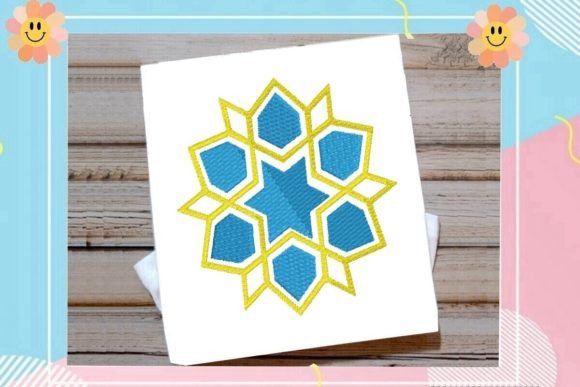
Geometric Patterns of the East: A Merch Review
As an embroidery designer who regularly consults with small businesses on merchandise development, I approach every new machine embroidery design with a critical eye toward production viability and brand alignment. When evaluating "Geometric Patterns of the East," my immediate assessment focuses on how this Moroccan-inspired Zellige pattern translates from a digital screen to a tangible business asset. This is not merely a decorative file; it is a potential cornerstone for brand identity in sectors ranging from artisanal cafés to boutique retail. The intricate nature of Zakhrapha motifs offers a distinct visual language that signals craftsmanship and cultural appreciation, but it also demands specific technical considerations for commercial application.
Visual Personality and Brand Alignment
The first impression of Geometric Patterns of the East is one of structured elegance and artisanal depth. Unlike generic geometric fills, the Zellige inspiration provides a sense of history and intentionality. For a small business owner, this matters immensely. In the crowded marketplace of small business merch, customers are drawn to items that feel curated rather than mass-produced. This design projects a premium, handmade aesthetic that aligns perfectly with creative studios, florists, bakeries, and ethical fashion brands.
However, the complexity of the pattern dictates its personality. It feels professional yet warm, avoiding the sterility of corporate vector art while maintaining enough symmetry to look intentional on uniforms. If your brand voice is rustic, organic, or culturally rich, this embroidery file supports that narrative. Conversely, if your brand relies on minimalist modernism or high-tech sleekness, the ornate nature of these African and Middle Eastern influences might create visual dissonance. Always compare this design beside your existing design assets to ensure it enhances rather than competes with your current logo suite.
Commercial Applications for Small Business
In real-world scenarios, Geometric Patterns of the East performs exceptionally well as a supporting graphic element rather than a primary logo. Its strength lies in texture and border work. Here is how I envision this design functioning across various commercial embroidery projects:
- Apron Embroidery: For cafés and potteries, placing this pattern along the hem or pocket edge of an apron adds a layer of sophistication without interfering with the primary chest logo. It turns a utilitarian garment into a branded experience.
- Tote Bag Design: Canvas totes are staples for Etsy sellers and markets. This pattern works beautifully as a centered motif or a repeating border, utilizing the natural texture of canvas to complement the geometric stitches.
- Staff Uniforms: On work shirts or tunics, use this as a sleeve detail or cuff accent. It provides visual interest that distinguishes staff apparel from generic polos while reinforcing the business’s attention to detail.
- Product Packaging: Consider embroidering this onto fabric dust bags or reusable wrapping. It elevates the unboxing experience for handmade product sales, justifying higher price points through perceived value.
- Event Merch: For festivals or pop-ups, this design serves as an excellent backdrop for text-based event branding, adding color and cultural resonance to limited-edition items.
Technical Constraints and Production Warnings
While visually stunning, Geometric Patterns of the East requires careful handling during digitization review and production. The Zellige style inherently involves dense tiling and precise alignment. As a designer, I must flag several areas where caution is necessary to avoid production failures or poor-quality results.
Stitch Density and Fabric Texture
Moroccan tile patterns often require high stitch density to achieve solid coverage and sharp definition. On lightweight fabrics like performance tees or thin linen, this density can cause puckering or distortion. You must pair this design with appropriate stabilizer; a cutaway stabilizer is often non-negotiable for maintaining the geometric integrity of the Zakhrapha motifs. Always test on the actual fabric texture you intend to use before running a full production batch. What looks crisp on heavy denim may sink into loose-weave cotton.
Sizing and Detail Retention
This design likely has a minimum viable size. Reducing complex geometric patterns too aggressively causes stitch overlap and thread breaks. Before committing to cap embroidery or small patches, verify the smallest recommended dimensions in the file specifications. Caps present additional challenges due to curvature; flat geometric patterns can distort on the rounded front panel. I recommend testing on a curved cap template first. Similarly, for embroidered patch applications, ensure the merrow border or satin stitch edge does not encroach upon the intricate internal details of the Zellige pattern.
Thread Colors and Contrast
The description mentions colorful motifs. In custom apparel production, thread availability and color matching are logistical realities. Review the required thread colors against your inventory. High-color-count designs increase machine runtime and thread change frequency, impacting cost-per-unit. Furthermore, consider contrast. Intricate geometry disappears if the thread color matches the fabric too closely. Test in black and white first to evaluate value contrast independent of hue. If the design relies heavily on shading, ensure your machine can handle the gradient transitions smoothly.
Impact on Customer Trust and Perceived Value
Why invest in a complex design like Geometric Patterns of the East instead of a simple shape? The answer lies in consumer psychology. Detailed embroidery signals investment. When a customer receives a finished product featuring precise, multi-colored geometric stitching, they subconsciously associate that care with the business itself. It builds trust. Sloppy, sparse, or poorly registered embroidery suggests corner-cutting. By choosing a high-quality design and executing it correctly, you communicate that your business values excellence.
This design also aids in visual consistency across diverse product lines. Whether applied to a ceramicist’s smock or a spa’s towel set, the recurring geometric theme creates a cohesive brand universe. For Etsy sellers, this consistency makes shop photos look professional and curated, directly influencing buyer engagement and conversion rates.
Designer Notes for Pre-Production Success
Before loading this digital embroidery file into your machine for client work, follow this professional checklist to mitigate risk:
- Verify Specifications: Confirm the exact stitch count, hoop size requirements, and physical dimensions. Do not assume standard sizing for such specialized artwork.
- Create a Printable Mockup: Generate a realistic mockup to show clients exactly how the Zellige pattern will scale on their chosen merchandise. Manage expectations regarding size and color placement.
- Run a Physical Sample: Never skip the sew-out. Inspect registration marks, pull compensation, and edge definition. Adjust tension if the geometric lines appear wavy.
- Check Licensing: Ensure you have the appropriate commercial license for selling merchandise featuring this design. Protect your business legally.
- Evaluate Washability: If producing uniforms or aprons, wash-test the sample. Dense geometric embroidery can be abrasive; ensure it withstands industrial laundering without fraying.
- Assess Hoop Stability: Given the likely density, use the smallest hoop possible that accommodates the design to maximize fabric tension and reduce shifting.
Geometric Patterns of the East is a powerful tool for businesses seeking to elevate their merchandise beyond basic branding. Its Moroccan Zellige heritage brings warmth and complexity that resonates with customers valuing artisanal quality. However, its success depends entirely on respectful technical execution. Treat this design with the precision it demands, and it will serve as a lasting emblem of your brand’s commitment to beauty and craftsmanship. Always prioritize testing and material compatibility to ensure your apron embroidery, tote bags, and uniforms reflect the same excellence as the products you sell.